Flynne Fisher
The PeripheralFlynne Fisher’s first encounter with the future begins as a job, but quickly becomes an investigation into a crime and the violence spreading around her family. A skilled gamer from Clanton who works because she needs the money, she connects through a phone and HaptRec to a remote body in another time. The crossing gives her access to a world she could not otherwise enter—and puts her in danger on both sides of the connection.
Identity and Background
Flynne is not drawn to gaming for its own sake. She has played for money, and her experience includes a particular rank and mission in Operation Northwind at which she became so effective that Dwight would not use anyone else. She knows that distinction may not last: the work had been the best-paid job she had found, but she doubts she will be doing it again. Her competence is rooted in practice and need, not in the leisure or private wagers of the rich.
Her habits also reflect lessons from Burton and the Corps. Before a job, she cleans up and gets dressed rather than working in the clothes she has been sitting around in; she connects getting herself squared away with getting her intent squared away. The routine once mattered when she was Dwight’s recon point. Even as the work changes, she carries this disciplined preparation into situations she does not yet understand.
Crossing into the Future
Flynne’s first connection comes through a gaming interface. After checking Badger’s county map and seeing Shaylene’s badge at Forever Fab, she bends her phone for gaming, enters HaptRec and submits the login. The display flashes silver, and she begins rising from what Burton had described as the launch bay in a van. She has no control yet. Instead, urgent, faint whispers surround her, followed by the view of a rainy city, a lead-colored river and distant towers.
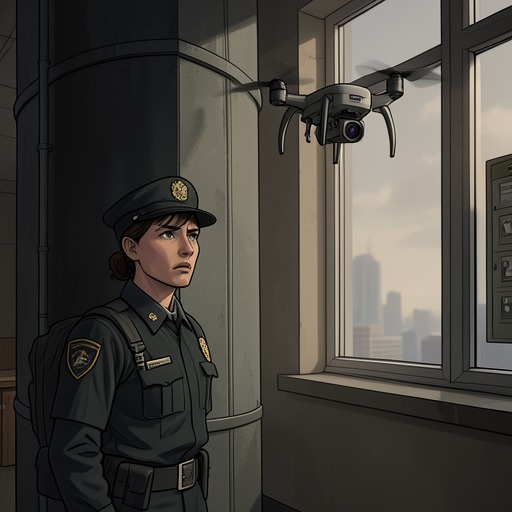
The connection does not make the remote body a safe instrument. Watching a couple from above, Flynne moves closer to see them. A narrow opening appears, and a small object darts out; something then scores the forward camera with repeated, insect-quick scratches. She retreats, drops several floors and lets the gyros catch her. The camera remains damaged but usable. The episode establishes that looking through the peripheral exposes her to physical interference: remote observation is an action with risks, not a protected view from nowhere.
A later attempt to cross makes the divide between bodies especially strange. With Burton’s display, Edward, and Macon in view, Flynne follows instructions to close her eyes and count down. At first she thinks nothing has happened. When she opens her eyes, the room has reversed: a different ceiling is higher above her, the crown’s weight is gone, her stomach feels upside down, and a woman’s blurred eyes are close. Her repeated attempts to understand what she is seeing make the transition a problem she must test, rather than a seamless escape into another body.
Witness and Investigator
The future’s authorities explain that Flynne is there because she chose to stand in for her brother; in doing so, she witnessed the crime under investigation. Detective Inspector Ainsley Lowbeer approaches her in privacy mode, with the surrounding crowd and traffic muted. Flynne asks whether Lowbeer is the reason for her presence, but Lowbeer places responsibility on Flynne’s own choice. The answer links her new role as a witness to the earlier act of taking her brother’s place.
Flynne does not accept the people around the investigation as automatically trustworthy. In a meeting with Ash and Wilf, she recalls playing a game for a wealthy man because she needed the money. The rich participants had treated it as a hobby and wagered on the result, while for her the money mattered. She draws a pointed distinction between those interests and the claim that the future operation is merely security for a game: if it is only a game, she asks, why were men sent to kill not just Burton but everyone around him, including her mother? She also presses Wilf on how he knew the winning lottery number. Her questions test the gap between the official explanation and the consequences she has seen.
Violence at Home
The investigation’s danger is not confined to the future. At the roadside scene on Porter, white flowers carpet the ditch and conceal its shape; Flynne recognizes a place she has walked past many times, now transformed by lights and a square white tent into a murder scene. A state policewoman stands nearby in a partly unzipped hazmat suit, and investigators emerge carrying two pistols in separate bags, one black and one a brightly colored fabricated weapon.
Later, Flynne connects the scene to Conner’s first night on the job and concludes that he killed the four men. She understands the act through the Corps’ fighting ethos, “speed, intensity, and violence of action”: when intelligence, plans or equipment fall short, decisive speed becomes the response. She contrasts that outlook with Burton’s emphasis on a “right way of seeing,” which she associates in part with his experience of hunting for food. The comparison gives her a framework for thinking about violence without making it abstract; she has to fit the principle to a local scene and to the people she knows.
Relationships and Agency
Flynne’s working relationships provide both practical support and points of friction. Shaylene brings salted-caramel cronuts to a meeting and arranges for Lithonia to watch the counter so the discussion will not be interrupted. Flynne remembers having worked at Coffee Jones, moving freshly printed cronuts to the oven carefully enough that their lattice would not collapse. The detail locates her among people whose work is ordinary, skilled and economically necessary—a sharp contrast to the wealthy players who treated her earlier gaming as entertainment.
Her ties to her family shape the stakes of the investigation. The future’s threat to Burton is inseparable from the danger to Flynne, their mother and the people around them; she refuses to regard an operation as harmless merely because its organizers describe it as a game. Her questioning also reveals a distinct kind of competence: she does not simply accept explanations from Ash or Wilf, but compares what they say with the deaths and risks visible in her own world.
That agency does not spare her from being vulnerable. After a dream that enlarges her town into a rich, Thames-like city, Flynne is taken by Reece, who has stunned her and tied her wrists to the car seat. She notices that Reece himself is frightened, and his fear alarms her more than the restraints alone. The episode reverses her usual position as the person trying to interpret danger: she is now confined, dependent on reading another person’s state, and uncertain what will happen next.
Change and Narrative Role
Flynne’s trajectory runs from paid gamer to unwilling witness and active questioner. Her first login gives her a view she cannot control; later encounters make clear that neither the future body nor the home world offers reliable safety. Yet she increasingly treats what she sees as evidence that demands an account. She asks who benefits, who knew what in advance, and why an ostensibly recreational contest has produced a threat to her family.
The crossings also unsettle the meaning of a stable point of view. Flynne can occupy an unfamiliar body and inspect her own world through a mediated interface, but bodily sensations and sudden reversals keep asserting the difference between connection and ordinary presence. When she stands in Soho Square and asks where she is, the answer is both geographically precise and newly estranging: she is in Soho, and the suggested route is a greenway toward Hyde Park. Her path through that landscape mirrors the larger change in her role—she has crossed into a world whose rules she must learn, while retaining the skeptical judgment formed by the life she left behind.